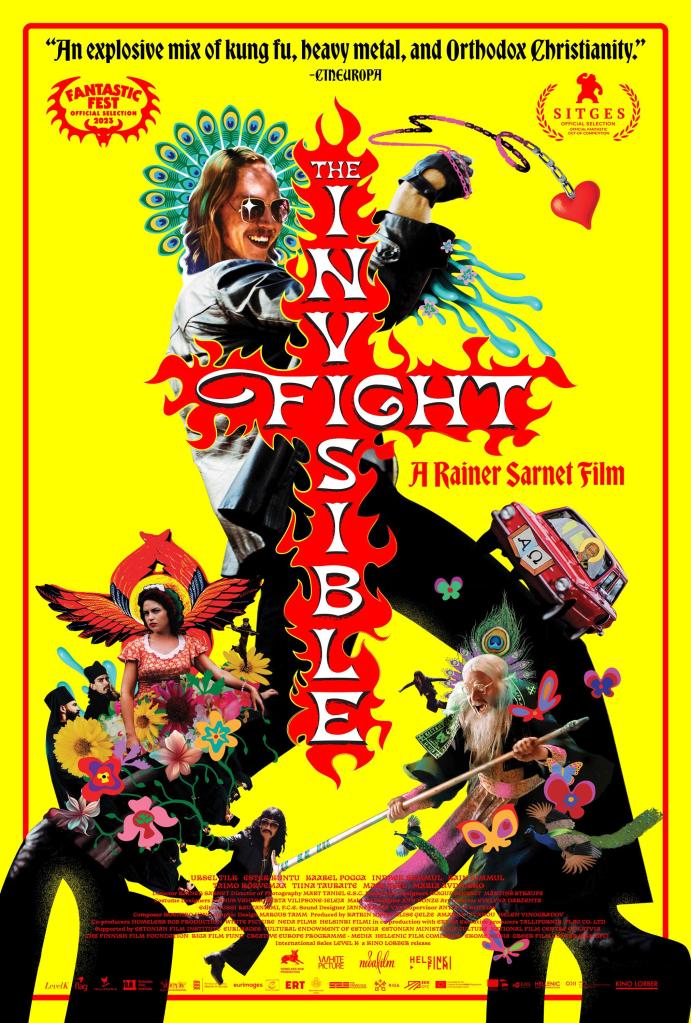
During my local independent movie theatre trailers – I saw one for this movie called “The Invisible Fight.” An Estonian movie about Russian Orthodox monks, Kung-Fu, Black Sabbath music, and the search for purpose set in the landscape of 1973 USSR. I was immediately hooked by the music, the scenes of seeing the characters flying through the trees like a scene straight out of “Crouching Tiger, Hidden Dragon” with their 70’s outfits. I was absolutely intrigued.
The movie I watched that night deserves a second viewing before I tackle it in a written review, so that’s for later. This post is about the film in the trailer, “The Invisible Fight.”
The movie opens with three Kung Fu fighters swiftly jumping through the trees and donning their black attire, long black hair, weapons, and a boom box that plays on repeat Black Sabbath. They make it to the USSR-China border with the year listed as 1973. The three fighters make their way through the compound and fight and kill all the Russian soldiers through a mix of fun fighting sequences and comedic scenes. One soldier, Rafael, remains confronted with the three fighters, one of whom throws down his nunchucks before walking away. With a captain’s last breath before dying laid up next to a wall, he tells Rafael, “God has other plans for you.”
Within these first couple of scenes, I was taken by how much I loved the physical comedy and music that tied the scene together.
I don’t pretend to be a bonafide movie critic, but I enjoy watching all the films I can—and I’ve never seen any movies that use physical comedy to the extent this movie has that were made in the last couple of years.
As the film progresses, Rafael is shown in his room practicing his nunchuck skills in front of his mirror next to a poster of Bruce Lee. Having survived the attack, he now rides his red car to work as a mechanic. His physicality demonstrates his carefree nature and embrace of his new path toward Kung Fu. This heading into kung-fu is much to his mother’s opposition, who is diligent about frying up his bread and guilt-tripping her son that his pursuit is not worth it. Rafael complained that everything cool was banned in the Soviet Union. I would love to understand and read more about the political landscape of the time, how that impacted the dissemination of global events and music, and how what was able to make it through the border impacted those individuals seeking and embracing novel ideas.
Rafael attends a dance, and the sequence unfolds with him finding a woman, and when he flirts, her partner punches him in the face. The scene cuts to Rafael the next day at work with his face bruised. The woman shows up in her lover’s car, and when she sees Rafael, she places Chanel No. 5 on his wounds. Rafael then appears at an Orthodox monastery where he seeks to be taught. A priest tells him to kick one monk so hard he flies, and Rafael, up to the challenge, does so, resulting in a comedic scene where the monk falls back to Earth yelling “hallelujah!” and then rejoicing in the receiving the gift of humility.
Rafael is told to leave as he is referenced to be a “clown,” he then goes to the catacombs to pray, and as all the monks surround him, it is shown that the image of Mary is crying a tear of honey. This prompts the head monk to take Rafael into the priesthood and begin his teaching as a monk to be his replacement, much to the apprehension and chagrin of his main student who now has to train Rafael. The film uses fight sequences and mentorship adventures. Rafael learns to shadow fight, follow his mentor’s instructions, and engage in funny physical comedy when faced with lessons on failing to show humility and the daily practice of patience, truth, and Love.
The film has a beautiful color scheme that shows the vibrancy of life set in the backdrop of a gray and industrial soviet environment, and the outfits and interactions help establish the setting of the Soviet Union. While I have limited exposure to the media from this period – I cannot comment on the political undertones of where state police try to gain entry into the monastery or understand how religion was viewed and embraced by the people living in the USSR. However, as someone raised Catholic, I felt familiar with the church monastery’s phrases, teachings, and routine. I loved a quote concerning Love (maybe it was “we all come from love” or something to that effect) and hope to rewatch the film to write it down accurately. It is one of those quotes that impacted me, provided comfort in a way I wasn’t expecting, and helped solidify why I love movies so much. It’s a beautiful portal into another world, life, and understanding.
Rafael’s journey is a quirky one, and while I enjoyed the segmented fights with two Orthodox “witches” and the adventures he embarks on, from pushing his car to the top of a hill and ultimately encountering a demon woman (intimated by the title scenes of “demon dance” etc.) who is ultimately a good character (I don’t know that I understood enough of why she was made to be a demon or the purpose in this line of the story), I enjoyed this movie.
When the movie ended, I spoke with my friends about what we thought; they needed guidance as they were not religious and needed to understand the promoted concepts. As a Catholic raised – I too cannot speak fully to the Russian Orthodox approach but thoroughly enjoyed the tropes as they weren’t overdone or preachy. I did approach my liking for the movie as an interesting parallel between the Kung Fu movies from the period of Bruce Lee in disseminating a captivating and entertaining hero journey through religious undertones/mysticism/Kung Fu. I took this movie as a Western approach to the same story and provided some translational understanding of the environment, culture, and depiction of the hero’s journey.
Or, this could be just a cool story with no additional meaning or undertones. I don’t intend to disrespect this interpretation; I am just trying to make sense.
I very much enjoyed seeing the visuals, the Holy Fool, and the monks jamming out to Black Sabbath. As I understand it, this was the only song used repeatedly (other music was used in the background, but the Black Sabbath song was itself a character harkening to the badassery of this alternate life in the monastery) as an indicator for crucial action scenes. I did not find this overwhelming or annoying to encounter multiple times. Overall, I really enjoyed this movie and hope to see more from the actors, writers, and director. It provided a good story, fantastic visuals, and nice physical comedy. It is not a life-changing movie, nor is it one where
I immediately thought, ‘This is Oscar-worthy’ (more to come on this train of thought about this issue with film awards, as someone with no stake or understanding of what goes into the Oscars or award shows like that – lol). Still, it is a refreshing take that reignited my appreciation for the movies and their impact on my life as it is now. I love that there are people out there making their visions into reality and all the work the actors put in to bring life to their characters.
If you’ve got time, this movie was a fun surprise.
 Liminal Leisure
Leave a comment